
RPGT and Stamp Duty When Buying or Selling a Factory in Malaysia
How RPGT and stamp duty work on a factory sale in Malaysia: current rates, the buyer's 3% retention, a worked example and the deadlines owners and buyers must meet.
Updated 27 Oct 2026 · PropertyMsia

In short: when a factory changes hands, the seller may owe Real Property Gains Tax (RPGT) on the profit, and the buyer pays stamp duty on the transfer. RPGT depends on who sells and how long they held the property. Stamp duty depends on the price or market value, whichever is higher. Knowing both before you sign helps you price the deal properly and avoid penalties.
Who pays what
- Seller (disposer): RPGT on the chargeable gain, under the Real Property Gains Tax Act 1976, collected by LHDN (HASiL).
- Buyer (acquirer): stamp duty on the Memorandum of Transfer (MOT, Form 14A) under the Stamp Act 1949, plus stamp duty on the loan agreement if the purchase is financed.
- Buyer, on the seller's behalf: a retention sum from the price that must be paid to LHDN.
RPGT rates for a factory
RPGT applies to all real property, so the same rates cover factories, warehouses, shop lots and land. The rate depends on the seller's category and the holding period, counted from the date of acquisition to the date of disposal (usually the date of the sale and purchase agreement).
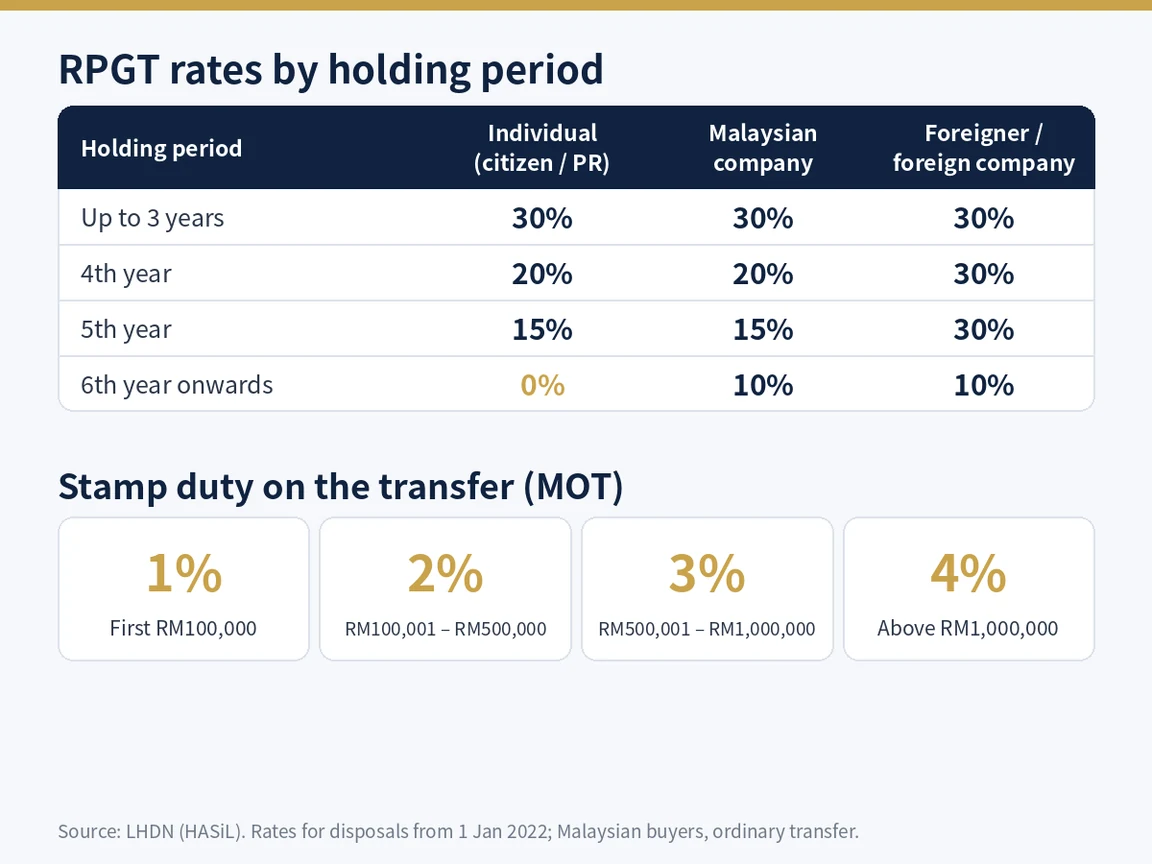
- Individual Malaysian citizens and permanent residents: 30% if sold within three years, 20% in the 4th year, 15% in the 5th year and 0% from the 6th year.
- Companies incorporated in Malaysia: 30%, 20% and 15% for the same periods, then 10% from the 6th year. Many factories are owned through a Sdn Bhd, so this row matters.
- Non-citizens and foreign companies: 30% up to the 5th year, then 10%.
How the gain is worked out
The gain is not simply selling price minus buying price. LHDN lets you deduct incidental costs of buying and selling, such as legal fees, valuation fees, agent commission and the stamp duty you paid when you bought, plus capital spending that raised or preserved the property's value and is still reflected at the time of sale (for example a new extension or a power upgrade). Keep the receipts. Individuals then get an exemption of RM10,000 or 10% of the chargeable gain, whichever is higher. Companies do not get this exemption.
The buyer's 3% retention
The buyer must hold back part of the price and remit it to LHDN within 60 days of the disposal date: 3% when the seller is an individual citizen or PR, 5% when the seller is a Malaysian company that held the property for up to three years (3% from the 4th year), and 7% when the seller is a foreigner. If the buyer fails to pay, LHDN adds a 10% increase. The amount is credited against the seller's RPGT, and any excess can be refunded after assessment.
Stamp duty on the transfer
For a Malaysian buyer, MOT stamp duty is charged on a sliding scale on the higher of the price or market value: 1% on the first RM100,000, 2% on the next RM400,000, 3% on the next RM500,000 and 4% above RM1,000,000. A sale to a foreign company or a non-citizen who is not a PR is charged a flat 4%. A loan agreement is generally stamped at 0.5% of the loan amount.
Worked example
An individual citizen bought a factory for RM1,500,000 and sells it in the 4th year for RM2,000,000. Assume RM50,000 of costs when buying and RM50,000 when selling.
| Disposal price (RM2,000,000 − RM50,000) | RM1,950,000 |
| Acquisition price (RM1,500,000 + RM50,000) | RM1,550,000 |
| Chargeable gain | RM400,000 |
| Less exemption (10% of gain, higher than RM10,000) | RM40,000 |
| RPGT at 20% on RM360,000 | RM72,000 |
| Buyer's retention, 3% of RM2,000,000 | RM60,000 |
| Buyer's MOT stamp duty on RM2,000,000 | RM64,000 |
If the same factory were sold by a Malaysian company, there would be no exemption, so RPGT would be 20% of RM400,000, which is RM80,000.

Deadlines and paperwork
- Both the seller and the buyer must file their RPGT return forms within 60 days of the disposal date. Since 1 January 2025, filing must be done online through e-CKHT on the MyTax portal.
- Stamp duty is submitted through the e-Duti Setem system on MyTax. Late stamping attracts penalties.
- Keep records for seven years, as LHDN may ask for them.
Practical tips
- Check the holding period before you sign: waiting a few months to enter the next year can lower the rate.
- Agree in the SPA how the retention sum will be handled, and let your lawyer manage the e-CKHT filing.
- Rates and rules change with each Budget, so confirm the current position with LHDN or a tax adviser before you commit.
Planning to buy or sell a factory? Contact PropertyMsia on WhatsApp and we will help you work through the numbers and find the right industrial property.
Talk to a registered agent for free advice on pricing, zoning and due diligence.
Get in touch Industrial Listings