Land Acquisition in Malaysia: The Process, Compensation and Your Rights
How compulsory land acquisition works under the Land Acquisition Act 1960: the Form A to Form K steps, how compensation is valued, the 5% late payment charge and the deadlines to object in court.
Updated 29 Oct 2026 · PropertyMsia
In short: the state government can compulsorily acquire private land under the Land Acquisition Act 1960 (Act 486), but only by following a set procedure and paying adequate compensation, as required by Article 13 of the Federal Constitution. Compensation is based on the market value of the land at a fixed date, plus certain losses. If you disagree with the amount, you have a short, strict window to object.
Who can acquire land, and why?
Under section 3 of the Act, the State Authority may acquire land needed for a public purpose (such as roads, rail lines, schools or drainage), for any person or corporation where the purpose is beneficial to the economic development of Malaysia, or for mining, residential, agricultural, commercial, industrial or recreational purposes. The process is run by the Land Administrator at the district land office (Pejabat Tanah), or by JKPTG for federal projects.
The process, step by step
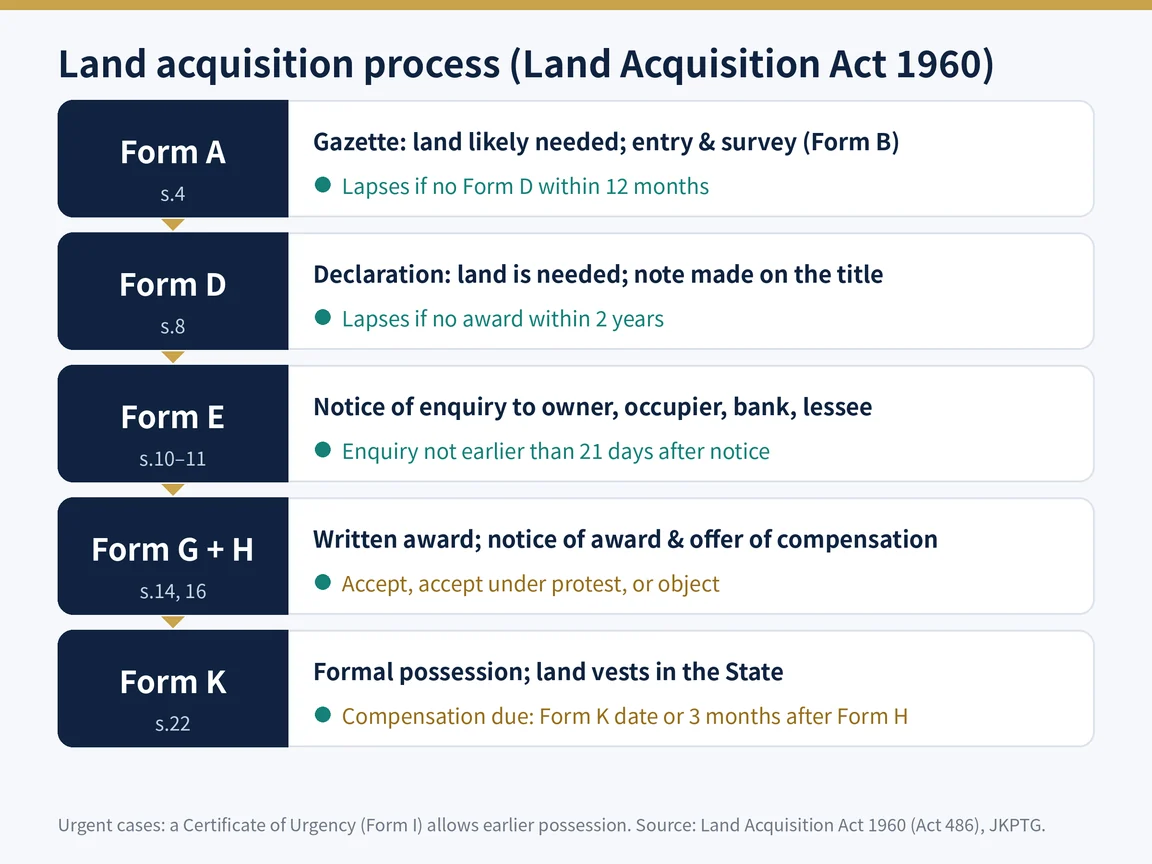
- Form A (section 4): a Gazette notice that land in an area is likely to be needed. Officers may enter to survey the land (Form B). Form A lapses if no Form D follows within 12 months.
- Form D (section 8): the declaration that the land is needed. The area is marked out and a note of the intended acquisition is made on the title. Form D lapses if no award is made within two years.
- Form E (sections 10 and 11): public notice of an enquiry, also served on the owner, occupier and anyone with a registered interest, such as a chargee bank or lessee. The enquiry cannot be held earlier than 21 days after the notice is published. Form F may ask you for a written statement.
- Enquiry and award (Forms G and H): the Land Administrator hears claims and evidence, then makes a written award (Form G) and serves each person a notice of award and offer of compensation (Form H).
- Form K (section 22): formal possession. The land then vests in the State, and the acquisition is recorded on the title. In urgent cases a Certificate of Urgency (Form I) allows possession earlier.
How compensation is worked out
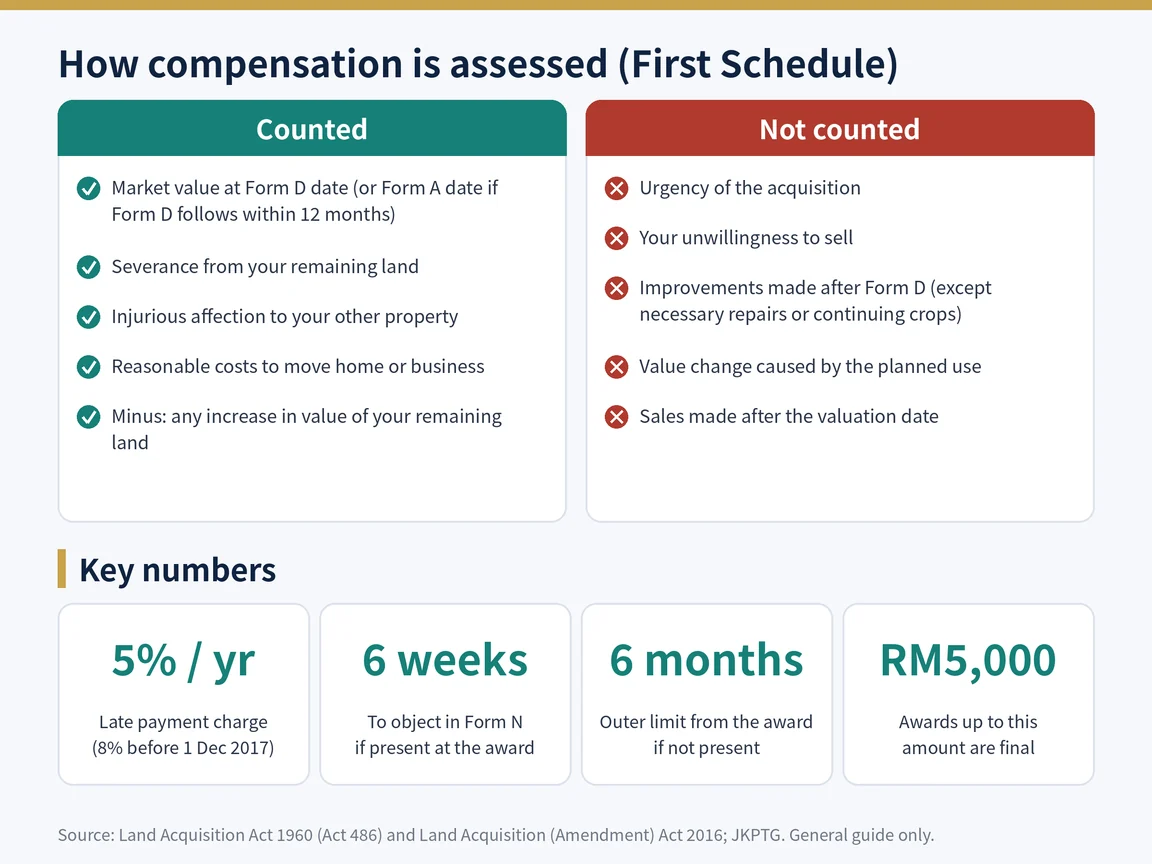
The First Schedule of the Act sets the rules. The core is the market value of the land at the date Form D is gazetted, or at the Form A date if Form D follows within 12 months. The valuer may consider recent sales of similar land nearby, but not sales made after that date. The title's conditions of use and the land use shown in the local development plan are taken into account. On top of market value, the award can include:
- Severance: damage from cutting the acquired part off from your remaining land.
- Injurious affection: other damage to your remaining property caused by the acquisition.
- Relocation: reasonable expenses if you must move your home or place of business.
Any increase in the value of your remaining land because of the project is deducted. The law also ignores the urgency of the acquisition, your unwillingness to sell, and improvements made after Form D, other than necessary repairs or continuing cultivation of crops.
Payment and late payment charges
Compensation is due on the date the land is taken (Form K) or three months after Form H is served, whichever is earlier. If it is paid late, a late payment charge of 5% a year applies from the due date. This rate has applied since the Land Acquisition (Amendment) Act 2016 came into force on 1 December 2017; it was 8% before. If the agency that wanted the land objects to the award in court, it may pay 75% first and withhold 25% until the case is decided.
If you disagree with the award
You can accept the payment under protest and still object. The objection is made in Form N to the Land Administrator, who refers it to the High Court. You may object to the measurement of the land, the amount of compensation, who it is paid to, or how it is shared. The deadlines cannot be extended by the court:
- If you attended or were represented at the award: within six weeks of the award.
- Otherwise: within six weeks of receiving Form H, or six months from the award, whichever ends first.
Awards of RM5,000 or less are final and cannot be objected to.
Practical tips for owners and buyers
- Before buying land, check the title search for a note of intended acquisition and ask the land office about planned roads or rail lines.
- Attend the enquiry. Bring your title, sale and purchase agreement, recent nearby sales, a report from a registered valuer, and records of buildings, crops or business income.
- State your claim carefully. If you name a figure at the enquiry, you cannot later be awarded more than that amount.
- Tell your bank if the land is charged; it will also be served notice.
- Diarise the six-week deadline from day one, and get advice from a lawyer and a registered valuer early.
Own land affected by an acquisition notice, or looking at land near a planned project? Chat with PropertyMsia on WhatsApp and we will help you check the land and understand your options.
Talk to a registered agent for free advice on pricing, zoning and due diligence.
Get in touch Land Listings